October 26, 2026, Canada · The Weather Network, by Dennis Mersereau
"Permanent Daylight Saving Time means major changes in Canada"
See Canada Time Zone Map with current time
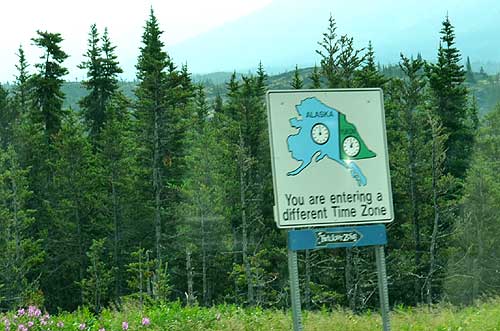
Sign "You are entering a different Time Zone" (time change entering Yukon from Alaska), Klondike Highway, Alaska-Yukon Territory.
WorldTimeZone.com
Permanent Daylight Saving Time means major changes in Canada
Five provinces and territories no longer observe the twice-yearly clock changes
For the first time in more than a century, only half of Canada will "fall back" this November after multiple provinces and regions made Daylight Saving Time (DST) permanent.
The dramatic change is long-awaited by folks who dislike how early the sun sets during the winter months. However, freezing the clocks year-round may have some unintended drawbacks.
A twice-yearly tradition ending in much of Canada.
Daylight Saving Time, sometimes called summer time, begins in March and ends in November.
The practice of "springing forward" by one hour in March started in the early 1900s as a way to make the most of long summer days, with clocks "falling back" an hour to the original (standard) time in November.
Modern life and advanced technology have largely made the agrarian need for an adjusted daylight schedule a thing of the past.
As a result, many people throughout countries that observe DST have pushed their political leaders to scrap the disruptive time adjustments, usually in favour of leaving clocks fixed on summer time that would provide later winter sunsets.
The movement picked up steam in 2026, culminating in significant changes throughout Western Canada.
Leaders in British Columbia, Alberta, Manitoba, parts of northwestern Ontario, and the Northwest Territories have chosen to make DST permanent beginning this year.
Saskatchewan and the Yukon stopped observing time changes in 1966 and 2020, respectively.
As of 2026, the twice-yearly time changes will continue across large swaths of Ontario, Quebec, Atlantic Canada, and Nunavut.
What time is it?
Figuring out the time in another province can prove challenging in a country as large as Canada. The western half of the country switching to permanent summer time will throw an additional wrench in the equation.
Vancouver will run either two or three hours behind Toronto depending on the season. Portions of the eastern B.C. Interior will remain aligned with Alberta's time zone.
Clocks in Saskatchewan, which opted to stick with standard time many decades ago, will remain synced with Alberta throughout the year. Meanwhile, Saskatchewan is now permanently one hour behind Manitoba as a result of this change.